
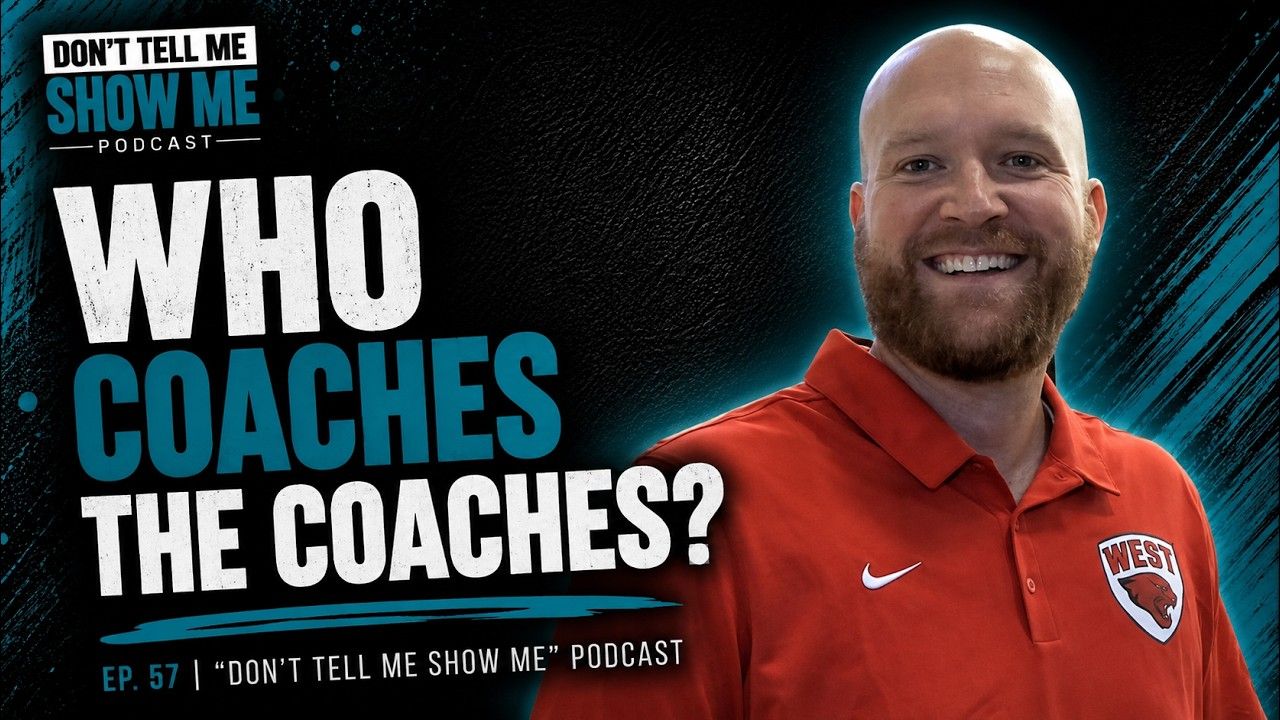
WHO COACHES THE COACHES?
Coaches invest enormous energy developing their athletes. Almost none developing themselves. This article is about the gap that creates, why it's so easy to ignore, and what it actually takes to close it.
The gap most coaches never name
At a certain point in your coaching career, the feedback stops. Not because you've mastered the craft — because the environment stops producing it. As a head coach, a senior teacher, an established practitioner, nobody tells you you're wrong anymore. Nobody says that's not good enough, or I disagree with you here. The challenge disappears, and what's left is what you've always done.
Most coaches mistake that absence for competence. A few recognise it for what it is: a gap.
We build entire systems to develop our athletes. We think carefully about how feedback lands, how challenge is calibrated, how trust is built before honest conversation becomes possible. And then we apply almost none of that thinking to ourselves. The coaches delivering development rarely receive it. The gap has a name, but most coaches never say it out loud: nobody is coaching the coach.
The moment that makes it visible
For most coaches, the gap only becomes visible in failure. Not ordinary failure — the specific kind where you've done everything you know how to do, your athletes are as prepared as you can make them, and it still isn't enough.
That moment produces one of two responses. Most coaches look outward — at the opposition, the decisions that went against them, the circumstances. A few look inward and ask a harder question: what if I'm the common thread here?
Not as self-criticism. As genuine inquiry. If I keep arriving at this same result with different athletes, different seasons, different circumstances — what's the one constant? And what would it take to find someone who could show me what I can't see myself?
Being coached is not the same as having a mentor
The distinction matters. A mentor shares their experience and their perspective. A coach — a real one — is actively invested in changing yours.
What genuine coaching support involves in practice: psychological safety built carefully over time, so that honest reflection becomes possible rather than performative. Real challenge — not the validating kind, but the kind that makes you rethink a position you've held for years. And accountability that doesn't disappear when the season gets difficult or the results go against you.
The rarest ingredient is the one that's hardest to find: someone who combines genuine expertise with genuine investment in you as a person. Not just someone who knows the game, but someone passionately interested in you as a human being — patient and relentless in equal measure.
Most coaches go their entire career without finding that person. The ones who do tend to look back and see a clear before and after.
"As a coach, I'm always there for people, but then no one is coaching my teaching and no one is coaching my coaching."
Watch yourself — the most confronting form of feedback
Before you find that person, or alongside finding them, there's a simpler form of feedback available that most coaches actively avoid. Film yourself.
Not a training drill. Not the match highlights. Film your pre-match talk. Film your halftime. Film your timeouts. Then watch them back — alone, without the result to soften what you see.
Most coaches who do this for the first time find similar things: they talk too long, athletes have stopped listening within the first minute, the board is packed with information that won't be retained, and halftime has no structural connection to what was said before the game. Not because they're poor coaches — because they've never had to look.
- What does your pre-match talk actually communicate? Is it a narrative about how you're going to compete, or a download of everything you know about the opposition?
- Does your halftime connect to what you said before the game? Can your athletes evaluate whether they're hitting the keys you agreed on?
- In your timeouts, who speaks, in what order, and what do your athletes remember when they step back onto the pitch?
The footage is honest in a way that memory isn't. It shows you what's actually happening rather than what you believe is happening. And that gap — between what you think you're doing and what the camera sees — is exactly where growth lives.
What changes when you're finally being challenged
The changes that come from genuine coaching support rarely start with tactics. They start with how you communicate — asking better questions, listening differently, tolerating silence long enough to hear an honest answer. Then they move into how you run a session. Then how you use your staff. Then how you think about your role.
They also tend to move beyond coaching entirely. Because your weaknesses as a coach are almost always connected to your weaknesses as a person. The coach who struggles to delegate on the touchline often struggles to let go elsewhere. The coach who needs to have all the answers in a timeout needs that in other rooms too. When someone finally challenges those patterns — and when you're in an environment safe enough to examine them — what changes isn't just your coaching.
"The best coaches I've worked with are the ones that explicitly share that journey with their athletes and their other coaches — say this is what I'm doing. I'm going to commit to something I'm not yet great at, but I believe it's the right thing for me to do, and you can help and support me with this."
That transparency — telling the people you coach that you are also being coached, that you are also working on something, that you also don't have all the answers — is one of the most powerful cultural moves a coach can make.
How to start
Two things matter more than anything else: identifying what kind of support you actually need, and finding the right person to provide it.
On the first: some coaches know exactly what they want to improve and are highly motivated — they need someone to challenge their thinking and give honest feedback. Others know something is missing but can't name it — they need someone to help them look. Others know what they need to change but have a track record of finding reasons not to — they need someone who will hold them to account when the season gets hard. These are different needs. Finding support that matches the wrong one wastes everyone's time.
On the second: start with one thing this season. Not the biggest thing — the most tractable one. Something you've been avoiding because it's uncomfortable, or convincing yourself you'll get to later. Put a plan behind it, not just an intention. And find someone who will still be asking about it in week eight.
Your challenge
Two questions to sit with before your next session. Who is currently coaching your coaching — not mentoring you, not supporting you, but actively challenging how you think and what you do? And if the honest answer is nobody, what are you going to do about it?
Connect!
Join our mailing list to receive the latest news and updates.
We hate SPAM. We will never sell your data, for any reason.